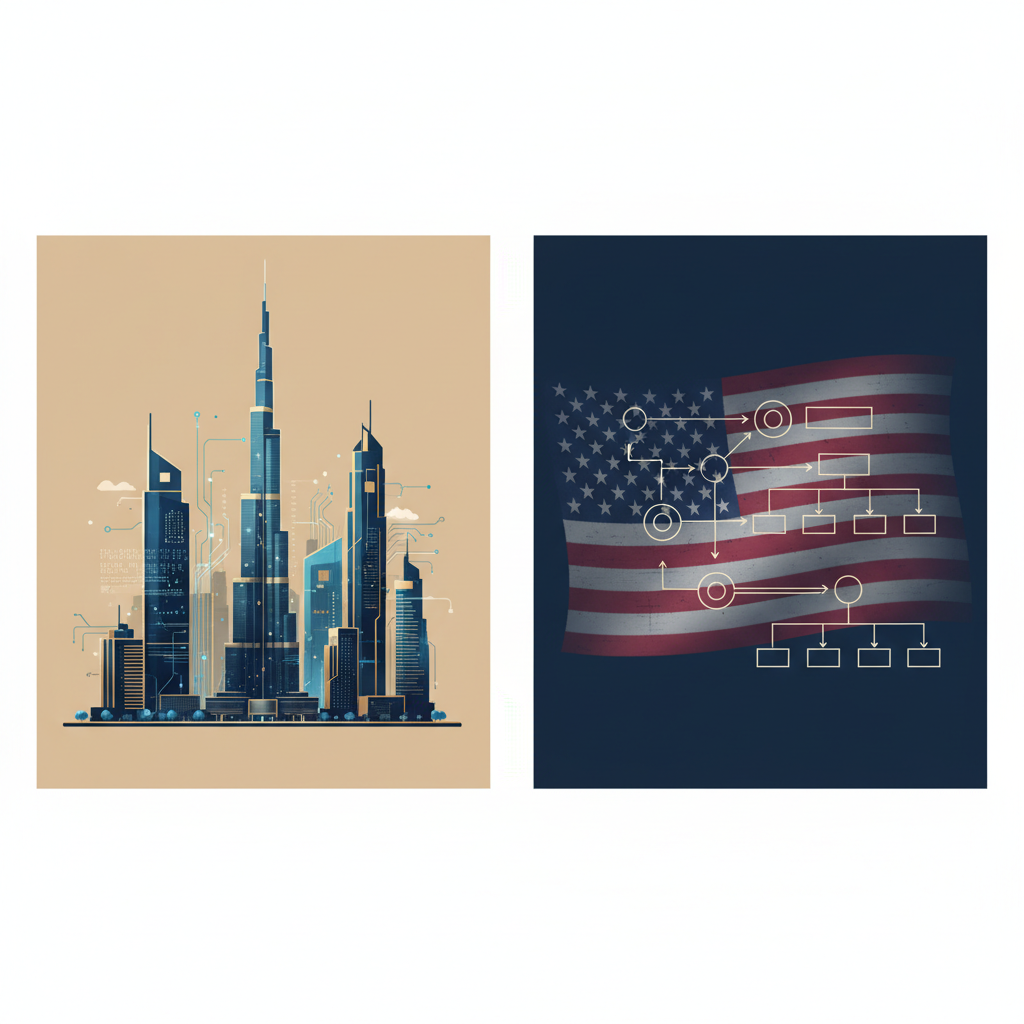
For non-US founders running a SaaS business, a dual company strategy combining a US LLC with a Dubai Free Zone entity can significantly streamline operations and optimize taxes in 2026. This setup offers the credibility of a US presence, essential for payment processing and investor appeal, while the tax efficiency and business-friendly environment of a Dubai Free Zone. Understanding the specific advantages and setup requirements for each component is crucial for successful implementation.
Why a Dual Company Strategy Works for SaaS Founders
SaaS businesses often need a strong international presence. A US LLC provides access to major payment processors like Stripe and PayPal, which are often challenging for companies registered solely outside the US. It also signals legitimacy to potential customers and investors globally, especially in North America.
Conversely, operating entirely within the US can expose a non-resident founder to higher tax liabilities and complex compliance. A Dubai Free Zone company offers a powerful solution to this, acting as the primary contracting and profit-generating entity. This separation optimizes both operational efficiency and tax outcomes.
The Role of the US LLC for Your SaaS Business
Your US LLC primarily serves as a gateway to the US market and its financial infrastructure. It can hold intellectual property, manage customer relationships, and secure essential US payment processing accounts. Most importantly, it allows your SaaS to accept payments directly in USD without significant foreign exchange complexities.
For non-resident single-member LLCs (SMLLCs) that do not have a US 'effectively connected income,' the US LLC is generally treated as a 'disregarded entity' for US tax purposes. This means income may not be subject to US federal income tax at the entity level, though reporting requirements (Form 5472 and 1120) are still mandatory.
Benefits of a Dubai Free Zone Company for SaaS
Dubai Free Zones (like DMCC or DIFC) offer an extremely attractive environment for SaaS businesses. They provide 0% corporate income tax, 0% personal income tax, and 100% foreign ownership, eliminating the need for a local partner. There are no restrictions on capital repatriation, allowing you to freely move profits.
Choosing the right Free Zone depends on your specific needs, though many offer similar benefits. For SaaS, Free Zones with strong tech ecosystems or specific licensing for digital services are ideal. This company will typically hold the main contractual relationships, manage development, and realize the majority of your SaaS profits.
Structuring Your Dual Entity Flow for SaaS
In a typical setup, the Dubai Free Zone company owns the intellectual property (IP) and enters into service agreements with customers worldwide. It then licenses its IP to the US LLC for promotional and sales activities within the US market. The US LLC collects payments from US customers and remits a portion (e.g., 90-95%) as a royalty or service fee back to the Dubai Free Zone company.
This flow ensures that most of your revenue is recognized in the tax-friendly Dubai Free Zone, minimizing your global tax footprint. Careful legal agreements (IP license agreements, service agreements) between the two entities are crucial for audit readiness. Transfer pricing considerations must also be handled correctly to avoid scrutiny.
Remote Formation and Banking Considerations
Forming a US LLC remotely is straightforward, often completed within days. You will need a registered agent in your chosen state (e.g., Wyoming or Delaware). Obtaining an EIN (Employer Identification Number) without an SSN or ITIN is also possible for non-residents by fax or mail.
Opening a US business bank account remotely for the LLC can be challenging but is achievable. Fintech solutions like Mercury, Wise, or Revolut offer viable options for non-residents. For your Dubai Free Zone company, several local and international banks (e.g., Emirates NBD, HSBC UAE, Mashreq Bank) cater to Free Zone entities, and remote account opening is often more feasible with assistance from a local corporate service provider.
Compliance and Operational Costs in 2026
Maintenance for a US LLC involves annual state fees ($50-$300 depending on the state), registered agent fees ($100-$150 annually), and tax filings (Form 5472 and 1120). Accounting services will cost between $1,000 and $3,000 per year for a basic setup.
Dubai Free Zone company costs include initial setup fees (AED 15,000-50,000, approximately $4,000-$14,000, depending on the Free Zone and license activity), annual renewal fees (similar range), and potentially visa charges if you require one. Audited financial statements are usually required annually for Free Zone companies, costing around AED 5,000-15,000 ($1,300-$4,000). While higher in initial and annual cost, the 0% tax environment can offer significant savings over time.
LLC cost calculator
Work out what an LLC actually costs to keep alive. Pick a state, a number of years and your Registered Agent price.
| State filing fee, once | $100 |
| Annual report, 4 renewals | $240 |
| Registered Agent, 5 years | $0 |
| Total over 5 years | $340 |
Estimate only. State fees are the published amounts at the time of writing and can change. Taxes, foreign qualification in your operating state and optional services are not included.
BF Solutions LLC, Sheridan, Wyoming. WY Filing ID 2026-001992102.
We file with the Secretary of State and apply for your EIN with the IRS.
Most US LLC filings are completed in a few business days, EIN follows after approval.
Talk to the team that handles your file, before and after formation.
Frequently asked questions
Can I form both a US LLC and a Dubai Free Zone company without being physically present?+
Yes, both entities can be formed remotely using registered agent services for the US LLC and corporate service providers for the Dubai Free Zone company.
What are the main tax implications for a US LLC owned by my Dubai Free Zone company?+
The US LLC, if structured as a disregarded entity and without US effectively connected income, generally will not pay US federal income tax, but must file informational returns Form 5472 and 1120.
How does the dual company structure help with payment processing for SaaS?+
The US LLC provides a US presence to easily integrate with payment gateways like Stripe and PayPal, allowing you to accept payments from US customers without issues. These funds can then be transferred to your Dubai Free Zone entity.
Which Dubai Free Zones are best suited for a SaaS business?+
Free Zones like DMCC (Dubai Multi Commodities Centre), DIFC (Dubai International Financial Centre), and DAFZ (Dubai Airport Freezone) are popular choices for tech and knowledge-based businesses, offering specific licenses for SaaS activities.
Do I need a physical office in Dubai if I operate from a Free Zone?+
Many Free Zones offer 'flexi-desk' or virtual office solutions that meet the minimum physical presence requirements, allowing you to operate without a full-time physical office space.
What is the typical timeframe for setting up both entities?+
A US LLC can be set up in 1-2 weeks. A Dubai Free Zone company typically takes 2-4 weeks, assuming all documents are in order and clearances are swift.
Are there any currency exchange challenges with this dual structure?+
The US LLC typically collects USD, which can be transferred to the Dubai entity. While the UAE Dirham (AED) is pegged to the USD, exchange rates for other currencies when dealing with international clients may involve minor fees or fluctuations.
Open your US LLC the easy way
Formation, EIN and Registered Agent in one fixed-price package. Real humans on WhatsApp when you need help.
Bastion Formations is a company formation agent that files LLCs and corporations in all 50 US states and incorporates companies in the UAE, UK, Hong Kong, Singapore, Canada, Thailand and Indonesia. Our team files with the Secretary of State directly, applies for EINs with the IRS and supports founders through bank account opening. This article reflects fees and filing rules we work with day to day.
- Registered entity
- BF Solutions LLC
30 N Gould St Ste R, Sheridan, WY 82801, USA
WY Filing ID 2026-001992102 - UAE office
- Online Solutions LLC, Licence 2221203
Sharjah Free Zone, United Arab Emirates
Fees checked and article last updated on September 18, 2026. State fees can change, so confirm before you file.